
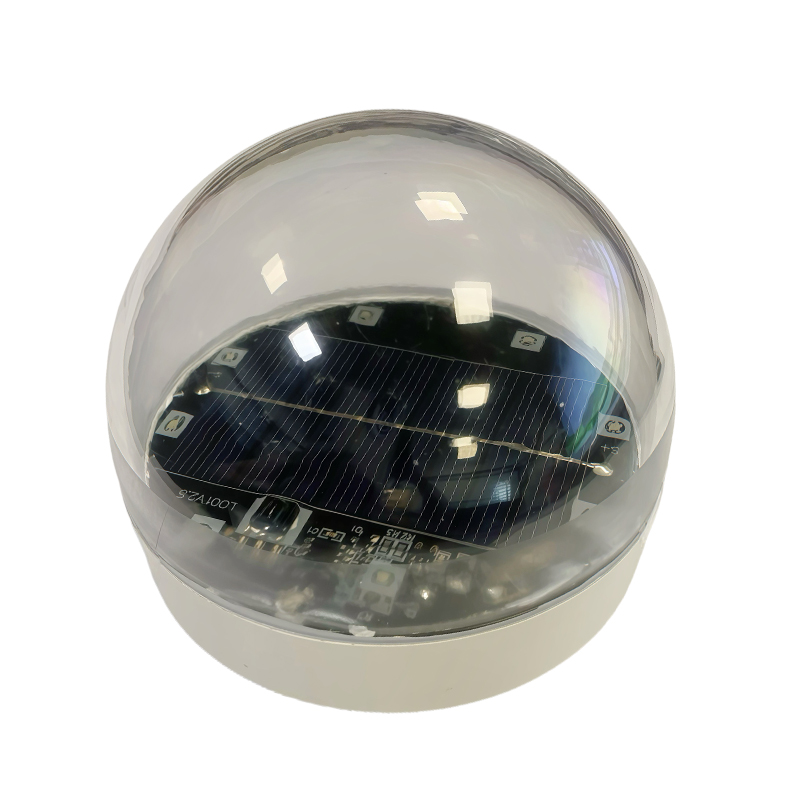


How can solar pool lights ensure normal operation of solar charging and lighting under complex weather conditions?
Release Time : 2026-03-05
To ensure the normal operation of solar charging and lighting under complex weather conditions, solar pool lights require a multi-dimensional technological synergy, including high-efficiency solar energy conversion, intelligent charge and discharge management, environmental interference resistance design, dynamic spectral adjustment, enhanced physical protection, a modular maintenance system, and multi-energy collaborative replenishment. This synergy is crucial for building a stable operating mechanism adaptable to various scenarios.
High-efficiency solar energy conversion is the core foundation for coping with complex weather conditions. Solar pool lights generally use monocrystalline silicon solar panels, whose photon absorption efficiency is significantly higher than that of traditional polycrystalline silicon. Even on cloudy or rainy days or in environments with diffused light, they can still capture weak light and convert it into electricity. Some high-end products utilize tandem cell technology to absorb different wavelengths of the spectrum in layers, further broadening the range of solar energy utilization. For example, during prolonged cloudy or rainy weather, optimized solar panels can maintain a higher proportion of power generation efficiency compared to sunny days, providing a basic guarantee for the energy storage system.
Intelligent charge and discharge management is key to maintaining lighting stability. The intelligent controller built into solar pool lights has dual adjustment functions of light sensing and time control, which can monitor ambient light intensity and battery power in real time. When sunlight is insufficient, the controller automatically switches to a "low-power charging mode," extending battery life by reducing charging current. At night, it dynamically adjusts lighting brightness based on remaining battery power, prioritizing basic lighting needs. For example, after several consecutive days of overcast and rainy weather, the system prioritizes allocating power to maintain low-brightness lighting, preventing complete shutdown due to depletion of battery.
Environmental interference resistance design is optimized for complex weather conditions. Swimming pool environments are humid and windy, requiring fully enclosed structures with UV-resistant PC or ABS composite materials for the casing to ensure no leakage even after prolonged immersion in water. The solar panel surface is covered with a nano-hydrophobic coating, automatically forming water droplets that roll off, reducing the impact of water residue on light transmittance. Furthermore, the weighted design at the bottom of the light fixture, combined with a buoyancy structure, ensures stability even in strong winds or wave impacts, preventing a decrease in charging efficiency due to tilting.
Dynamic spectral adjustment technology enhances lighting performance in special weather conditions. In foggy or rainy conditions, traditional white light is easily scattered by water vapor, resulting in a reduced illumination range. Some solar pool lights utilize red-yellow light composite technology to increase the proportion of long-wavelength bands in the spectrum, enhancing light penetration. For example, in red-dominant mode, the light propagates significantly further in fog compared to white light, while the superimposed yellow light creates a warm-toned halo, satisfying both lighting needs and creating a comfortable atmosphere.
Physical protection enhances their ability to withstand extreme weather challenges. Addressing the risk of flooding during heavy rains, the lights meet IP68 waterproof standards, allowing for continuous operation at greater depths without damage. The battery compartment features an independently sealed design, ensuring the internal battery remains dry even if water enters the light's casing. Furthermore, the solar panel bracket is equipped with an adjustable angle device, allowing users to adjust the tilt angle according to seasonal changes or sudden weather events (such as typhoons) to maximize sunlight reception and reduce wind resistance.
A modular maintenance system reduces long-term operating costs. Solar pool lights employ a modular design, allowing independent replacement of the solar panels, batteries, and LED light clusters. For example, when battery capacity degrades due to frequent charging and discharging, users do not need to replace the entire system; simply replacing the battery module restores performance. Some products also support remote monitoring, allowing users to view charging status and fault warnings in real time via a mobile app, enabling early detection of potential problems and scheduling of maintenance.
Multi-energy collaborative replenishment enhances system reliability. In extreme, continuous rainy weather, solar charging may not meet nighttime lighting needs. In such cases, external mains power or a small wind turbine can be used as auxiliary energy to replenish the battery. The intelligent control system automatically prioritizes solar power, only activating backup energy when power is insufficient, reducing operating costs while ensuring continuous lighting. This "active and passive" energy strategy enables solar pool lights to operate stably for extended periods under various climatic conditions.