
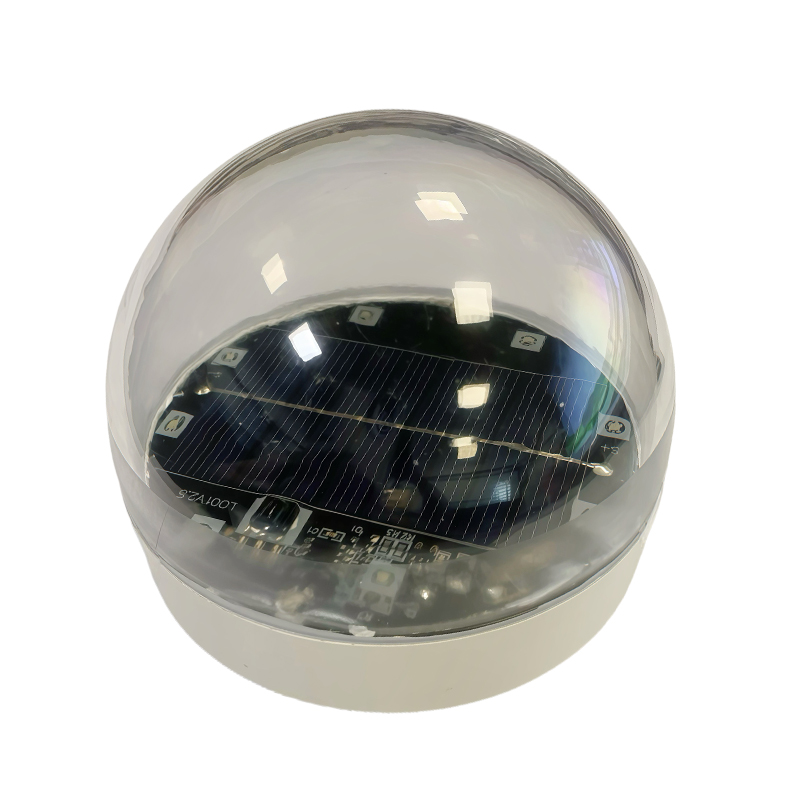


How do garden fountain special lights maintain their luminous efficacy and structural integrity under dynamic water flow impact?
Release Time : 2025-12-16
With the development of landscape lighting technology, garden fountain special lights have evolved from simple lighting tools into core elements for creating an artistic atmosphere in water features. Whether at the edge of a swimming pool, in the center of a square fountain, in a pond beside a garden path, at the foot of a landscape rockery, or even in an indoor lazy river, on the steps of a park pavilion, or on the surface of a lotus pond, fountain lights must operate stably under complex conditions such as continuous water flow, water pressure fluctuations, and even foot traffic. Especially in dynamic water flow environments, the lights must not only withstand physical impacts but also ensure that their luminous efficacy does not decrease over time, their structure does not break, and their electrical circuits do not short-circuit.
1. High-strength sealed structure to resist water flow impact
Fountain lights are constantly underwater or in water splash areas, so their housings must possess extremely high mechanical strength and sealing performance. Mainstream products use 316L stainless steel, high-strength engineering plastics, or aluminum alloys as housing materials, which can resist fatigue damage caused by high-speed water flow impacts and also have excellent corrosion resistance. The key lies in its IP68 or even IP69K protection design—through multi-layered O-ring seals, ultrasonic welding, or laser sealing processes, it ensures that even in environments with water depths of 0.5–3 meters and rapid currents, water cannot penetrate the internal circuitry. Furthermore, the light-transmitting cover is typically made of thickened tempered glass or high-transmittance polycarbonate, resistant to pressure and impact, preventing breakage due to water hammer or foreign object impact.
2. Streamlined and Low-Resistance Design Reduces Hydrodynamic Load
To reduce the impact of water flow on the lamp body, professional fountain lights generally adopt a streamlined or flat embedded structure, making it parallel to or flush with the mounting surface in the direction of water flow, effectively dispersing water pressure and preventing eddies. Some products also feature flow channels or buffer chambers, forming a "water film protective layer" when strong jets of water pass through, further buffering direct impact. This aerodynamic approach significantly improves the structural stability of the lamp in dynamic water environments.
3. High-Efficiency Heat Dissipation and Optical System Ensure Long-Term Light Efficiency
Although LEDs are cold light sources, in a confined underwater environment, heat is difficult to dissipate through convection, easily leading to increased junction temperature, causing light decay, and even chip failure. Garden fountain special lights utilize a metal substrate, thermally conductive silicone grease filling, and an integrated housing heat dissipation design to efficiently conduct heat to the external water body—water's thermal conductivity is far higher than air, making it a natural heat dissipation medium. Simultaneously, the optical lenses use UV-resistant and hydrolysis-resistant materials, combined with a precise light distribution design, maintaining high light transmittance and color consistency even after long-term immersion, ensuring clear and dynamic light and shadow even amidst splashing water.
4. Multiple Safety Features and Intelligent Adaptability Enhance Reliability
For high-traffic areas such as swimming pools and lazy rivers, fountain lights strictly adhere to SELV standards, typically using 12V or 24V DC power, and are equipped with isolation transformers and leakage protection devices to eliminate the risk of electric shock. Furthermore, modern products increasingly integrate intelligent control modules that can change colors in sync with the water flow rhythm, but their circuit boards are all coated with conformal coating to ensure stable operation of electronic components in high-humidity and high-salt environments.
5. Wide Range of Applications, Enhancing Engineering Flexibility
Thanks to its modular design and multiple installation methods, garden fountain special lights can be flexibly applied to various scenarios, including still water surfaces in lotus ponds, cascading water features in parks, and artificial waterfalls. Whether the water flow is gentle, gushing, or circulating, the lights, with their robust structure and reliable sealing, silently withstand the ever-changing water conditions while providing dreamlike lighting effects.
The exceptional performance of garden fountain special lights in dynamic water flow is the result of a deep integration of materials science, structural engineering, optical design, and electrical safety. It not only illuminates the form of water but also protects the purity and durability of every beam of light with its robust construction. In the pursuit of harmonious coexistence between humanity and nature in landscape design, such lights are both a technological marvel and a carrier of art.
1. High-strength sealed structure to resist water flow impact
Fountain lights are constantly underwater or in water splash areas, so their housings must possess extremely high mechanical strength and sealing performance. Mainstream products use 316L stainless steel, high-strength engineering plastics, or aluminum alloys as housing materials, which can resist fatigue damage caused by high-speed water flow impacts and also have excellent corrosion resistance. The key lies in its IP68 or even IP69K protection design—through multi-layered O-ring seals, ultrasonic welding, or laser sealing processes, it ensures that even in environments with water depths of 0.5–3 meters and rapid currents, water cannot penetrate the internal circuitry. Furthermore, the light-transmitting cover is typically made of thickened tempered glass or high-transmittance polycarbonate, resistant to pressure and impact, preventing breakage due to water hammer or foreign object impact.
2. Streamlined and Low-Resistance Design Reduces Hydrodynamic Load
To reduce the impact of water flow on the lamp body, professional fountain lights generally adopt a streamlined or flat embedded structure, making it parallel to or flush with the mounting surface in the direction of water flow, effectively dispersing water pressure and preventing eddies. Some products also feature flow channels or buffer chambers, forming a "water film protective layer" when strong jets of water pass through, further buffering direct impact. This aerodynamic approach significantly improves the structural stability of the lamp in dynamic water environments.
3. High-Efficiency Heat Dissipation and Optical System Ensure Long-Term Light Efficiency
Although LEDs are cold light sources, in a confined underwater environment, heat is difficult to dissipate through convection, easily leading to increased junction temperature, causing light decay, and even chip failure. Garden fountain special lights utilize a metal substrate, thermally conductive silicone grease filling, and an integrated housing heat dissipation design to efficiently conduct heat to the external water body—water's thermal conductivity is far higher than air, making it a natural heat dissipation medium. Simultaneously, the optical lenses use UV-resistant and hydrolysis-resistant materials, combined with a precise light distribution design, maintaining high light transmittance and color consistency even after long-term immersion, ensuring clear and dynamic light and shadow even amidst splashing water.
4. Multiple Safety Features and Intelligent Adaptability Enhance Reliability
For high-traffic areas such as swimming pools and lazy rivers, fountain lights strictly adhere to SELV standards, typically using 12V or 24V DC power, and are equipped with isolation transformers and leakage protection devices to eliminate the risk of electric shock. Furthermore, modern products increasingly integrate intelligent control modules that can change colors in sync with the water flow rhythm, but their circuit boards are all coated with conformal coating to ensure stable operation of electronic components in high-humidity and high-salt environments.
5. Wide Range of Applications, Enhancing Engineering Flexibility
Thanks to its modular design and multiple installation methods, garden fountain special lights can be flexibly applied to various scenarios, including still water surfaces in lotus ponds, cascading water features in parks, and artificial waterfalls. Whether the water flow is gentle, gushing, or circulating, the lights, with their robust structure and reliable sealing, silently withstand the ever-changing water conditions while providing dreamlike lighting effects.
The exceptional performance of garden fountain special lights in dynamic water flow is the result of a deep integration of materials science, structural engineering, optical design, and electrical safety. It not only illuminates the form of water but also protects the purity and durability of every beam of light with its robust construction. In the pursuit of harmonious coexistence between humanity and nature in landscape design, such lights are both a technological marvel and a carrier of art.