


How can solar pool lights balance buoyancy control and bottom stability?
Release Time : 2026-01-13
In the field of outdoor water feature lighting, solar pool lights, with their advantages of no wiring, safety, environmental friendliness, and automatic operation, are becoming a finishing touch in gardens, villas, and public landscapes. However, the diversity of aquatic environments—from calm pool surfaces and surging fountain jets to winding streams and shallows—poses vastly different requirements for the physical adaptability of lighting fixtures: some scenarios require the fixtures to float lightly with the current; others require them to sink steadily and not be moved by the current. How to achieve both controllable buoyancy and reliable bottom stability in a single product has become a crucial art of balance that designers must master.
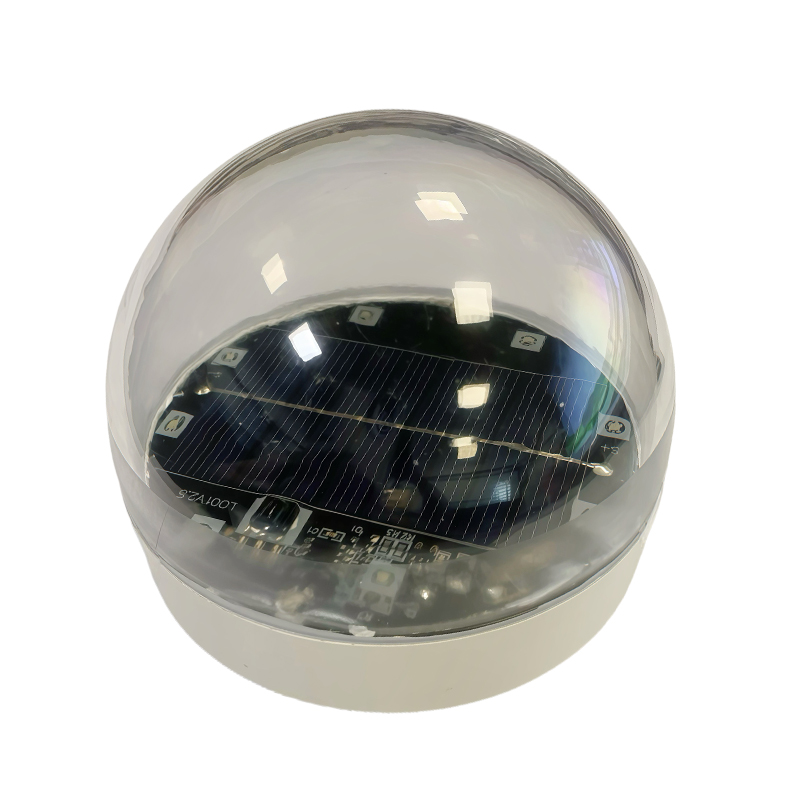
The core of this balance lies in the precise control of the center of gravity, density, and structural form. Solar pool lights typically use a one-piece sealed housing, integrating solar panels, LED modules, batteries, and control circuitry. To achieve buoyancy, the overall density needs to be slightly less than water, allowing it to float naturally. However, relying solely on buoyancy makes it prone to tumbling, gathering, or deviating from its intended position when disturbed by wind or water currents, affecting lighting effects and even obstructing vision. Conversely, simply adding weight for stability loses the graceful beauty of floating on water and makes it unsuitable for shallow water or areas with alternating wet and dry conditions.
Therefore, excellent designs for solar pool lights often incorporate adjustable counterweights or dual-state positioning mechanisms. For example, a detachable metal counterweight ring or silicone suction cup base can be embedded at the bottom of the light body. When used to create a floating effect in the center of a pool, removing the counterweight allows the light to float gently on the water like a lotus leaf; when placed at the bottom of a fountain or among rocks in a stream, attaching the counterweight or using the suction cup allows it to firmly adhere to a hard surface, resisting water impact. This modular approach allows the same light to freely switch between "floating" and "sinking" states depending on the scenario, greatly expanding its application boundaries.
Furthermore, the shape of the solar pool lights themselves also becomes a functional carrier. Streamlined or flat disc-shaped designs not only reduce water resistance but also create localized negative pressure through a micro-concave structure at the bottom, enhancing adhesion to the ground. The slightly heavier "gyro-like" distribution at the edges ensures that even during brief buoyancy, the light surface remains upward, preventing the solar panel from being submerged and unable to charge. Some high-end models even employ biomimetic concepts, mimicking the curved surface of pebbles or the flexible support of aquatic plants, visually blending into nature while providing physical stability.
Material selection is equally crucial. The outer shell primarily uses high-density engineering plastics or composite resins, ensuring IP68 waterproof sealing while allowing for adjustments to localized weight distribution through wall thickness. The internal battery compartment's position has been repeatedly simulated to ensure the center of gravity always falls within an ideal range—too high and it's prone to tipping over, too low and it's difficult to float. This millimeter-level attention to detail is the technological foundation for achieving "one light, multiple uses."
More importantly, behind this physical adaptability lies a profound understanding of real-world user scenarios. Designers understand that consumers don't buy lighting fixtures for a single water feature; they want a product that can flexibly adapt to the ever-changing landscape layout of their courtyards. Placed on the edge of a pool today, embedded in a rockery fountain tomorrow, and adorning a stream the day after—the versatility of these lights directly determines their long-term value and user experience satisfaction.
In conclusion, the ingenious balance between buoyancy and stability in solar pool lights is not simply a matter of adding or subtracting weight, but a comprehensive practice integrating fluid mechanics, materials science, and human-centered design. It allows technology to blend seamlessly with nature, and functionality to serve aesthetics, ultimately achieving the freedom of "one installation, everywhere." When night falls, whether the light rests quietly on the bottom of the pool or floats gently on the surface, it emits not only light, but also a wisdom of coexisting with water and adapting to its surroundings.
The core of this balance lies in the precise control of the center of gravity, density, and structural form. Solar pool lights typically use a one-piece sealed housing, integrating solar panels, LED modules, batteries, and control circuitry. To achieve buoyancy, the overall density needs to be slightly less than water, allowing it to float naturally. However, relying solely on buoyancy makes it prone to tumbling, gathering, or deviating from its intended position when disturbed by wind or water currents, affecting lighting effects and even obstructing vision. Conversely, simply adding weight for stability loses the graceful beauty of floating on water and makes it unsuitable for shallow water or areas with alternating wet and dry conditions.
Therefore, excellent designs for solar pool lights often incorporate adjustable counterweights or dual-state positioning mechanisms. For example, a detachable metal counterweight ring or silicone suction cup base can be embedded at the bottom of the light body. When used to create a floating effect in the center of a pool, removing the counterweight allows the light to float gently on the water like a lotus leaf; when placed at the bottom of a fountain or among rocks in a stream, attaching the counterweight or using the suction cup allows it to firmly adhere to a hard surface, resisting water impact. This modular approach allows the same light to freely switch between "floating" and "sinking" states depending on the scenario, greatly expanding its application boundaries.
Furthermore, the shape of the solar pool lights themselves also becomes a functional carrier. Streamlined or flat disc-shaped designs not only reduce water resistance but also create localized negative pressure through a micro-concave structure at the bottom, enhancing adhesion to the ground. The slightly heavier "gyro-like" distribution at the edges ensures that even during brief buoyancy, the light surface remains upward, preventing the solar panel from being submerged and unable to charge. Some high-end models even employ biomimetic concepts, mimicking the curved surface of pebbles or the flexible support of aquatic plants, visually blending into nature while providing physical stability.
Material selection is equally crucial. The outer shell primarily uses high-density engineering plastics or composite resins, ensuring IP68 waterproof sealing while allowing for adjustments to localized weight distribution through wall thickness. The internal battery compartment's position has been repeatedly simulated to ensure the center of gravity always falls within an ideal range—too high and it's prone to tipping over, too low and it's difficult to float. This millimeter-level attention to detail is the technological foundation for achieving "one light, multiple uses."
More importantly, behind this physical adaptability lies a profound understanding of real-world user scenarios. Designers understand that consumers don't buy lighting fixtures for a single water feature; they want a product that can flexibly adapt to the ever-changing landscape layout of their courtyards. Placed on the edge of a pool today, embedded in a rockery fountain tomorrow, and adorning a stream the day after—the versatility of these lights directly determines their long-term value and user experience satisfaction.
In conclusion, the ingenious balance between buoyancy and stability in solar pool lights is not simply a matter of adding or subtracting weight, but a comprehensive practice integrating fluid mechanics, materials science, and human-centered design. It allows technology to blend seamlessly with nature, and functionality to serve aesthetics, ultimately achieving the freedom of "one installation, everywhere." When night falls, whether the light rests quietly on the bottom of the pool or floats gently on the surface, it emits not only light, but also a wisdom of coexisting with water and adapting to its surroundings.