
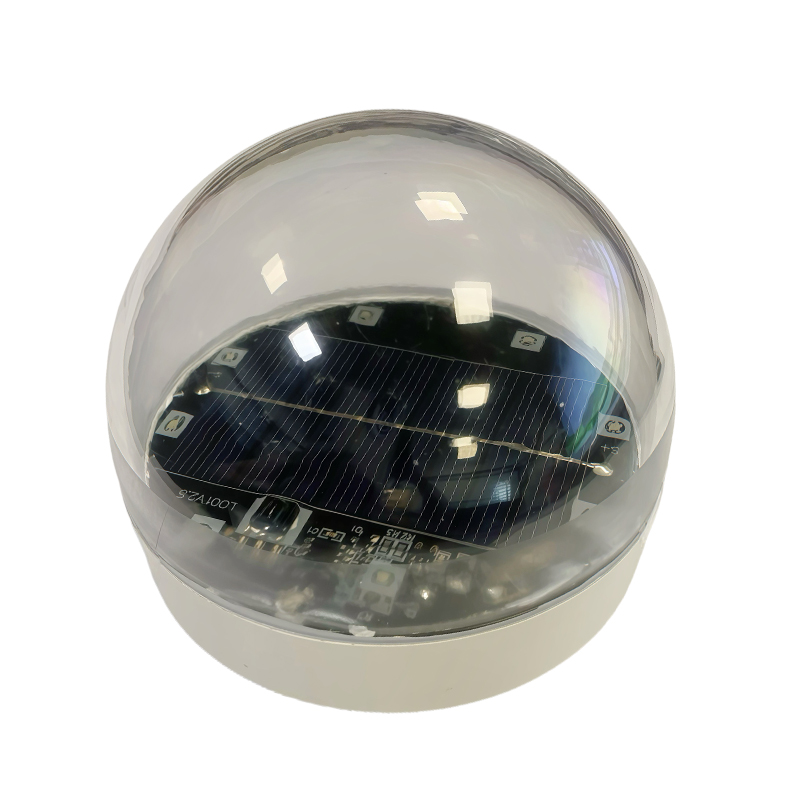


How can solar pool lights ensure continuous and stable lighting duration in cloudy weather?
Release Time : 2026-02-06
To ensure continuous and stable lighting duration under cloudy weather conditions, solar pool lights require a comprehensive solution encompassing multiple dimensions, including solar panel efficiency optimization, battery capacity matching, intelligent energy management system design, dynamic power adjustment of the lights, optimized installation location and angle, backup power integration, and regular maintenance and cleaning.
Solar panels, as the core component for energy harvesting, directly impact the charging capability of the lights in low-light environments. While solar radiation intensity is significantly reduced under cloudy conditions, scattered light can still be captured by high-efficiency solar panels. Solar panels employing monocrystalline silicon or PERC (passivated emitter and back contact) technology can significantly improve low-light response capabilities by optimizing cell structure and surface anti-reflective layers. Furthermore, increasing the solar panel area or adopting a bifacial power generation design can further increase light absorption, ensuring continuous battery charging even on cloudy days.
Battery capacity and charge/discharge performance are crucial for ensuring lighting duration. Since cloudy weather may last for several days, it is necessary to select lithium batteries with high cycle life and low self-discharge rates, such as lithium iron phosphate batteries, whose high-temperature resistance and overcharge/overdischarge protection characteristics extend their lifespan. Battery capacity needs to be matched to the lamp wattage and the expected number of cloudy/rainy days. For example, if a solar pool light has a wattage of 5W and operates for 8 hours a day, its daily power consumption is approximately 40Wh. If three consecutive days of cloudy lighting are required, the battery capacity should be no less than 120Wh, with a 20% margin reserved to cope with extreme conditions.
The intelligent energy management system dynamically adjusts charging and discharging strategies by monitoring light intensity, battery level, and the operating status of the solar pool lights in real time. In cloudy weather, the system prioritizes battery charging to prevent insufficient power due to excessive lamp consumption. When the battery level falls below a threshold, it automatically reduces lamp brightness or switches to intermittent lighting mode to extend battery life. Some high-end products also integrate weather forecasting algorithms to adjust energy allocation in advance, ensuring sufficient power reserves before prolonged cloudy days.
Dynamic adjustment of lamp wattage is a direct means of improving energy efficiency. Using high-efficiency LED light sources can maintain brightness while reducing power consumption. For example, reducing the lamp power from 10W to 5W results in only a 20% decrease in brightness, but doubles the battery life. Furthermore, integrating light or human body sensors allows solar pool lights to automatically dim or turn off when no one is present, further reducing energy consumption. Some products also support time-based dimming, such as full brightness for the first half of the night and half brightness for the second half, balancing lighting needs and energy consumption.
The installation location and angle of the solar panels directly affect light absorption efficiency. In cloudy weather, avoid blocking the solar panels from trees and buildings, and aim for a south-facing orientation (Northern Hemisphere) to maximize sunlight exposure. The tilt angle needs to be adjusted according to the local latitude. For example, in areas at 30° North latitude, the solar panel tilt angle should be set at 30°–40° to balance the absorption of direct and diffused light. For fixed installations, the angle can be manually adjusted periodically; for trackable installations, a motor drives the solar panels to follow the sun, maximizing charging efficiency.
Integrating backup power further enhances system reliability. In extremely cloudy or prolonged rainy weather, the solar panels' charging capacity is limited. In such cases, the battery can be supplemented by connecting to external AC power or a small wind turbine. Some products also support USB charging ports for convenient manual charging. The integration of backup power must consider waterproofing and safety to avoid short circuits or electric shock risks in humid environments.
Regular maintenance and cleaning are fundamental to ensuring the long-term stable operation of the system. Dust, bird droppings, or leaves accumulated on the solar panel surface can block sunlight and reduce charging efficiency. It is recommended to wipe the solar panel surface with a soft cloth monthly to keep it clean. At the same time, check for loose battery connections and aging light fixture seals to prevent malfunctions caused by poor contact or water ingress. Regular maintenance can extend the equipment's lifespan and ensure continuous and stable lighting even in cloudy weather.